Blue States = Better for Business? Or the HQs of Better Businesses? Surprise! U.S. Businesses Elect Ultra-Blue States as Best HQ Locations, 7:1 (vs. Ultra-Red States)

Are blue states or red states better for business?  Where would you locate the headquarters (HQ) of your company?  Are businesses in Democratic vs. Republican-leaning states more sustainable?  More responsible?  More ethical & transparent?  What do the numbers tell us?

Kyle Potvin (JD/MPP, UMass Dartmouth, 2013) and Amie Tailor (MBA, UMass Dartmouth, 2013) just finished checking and sorting the HQs of the 1,686 U.S. companies in CSRHub’s database (the world’s largest collection of ratings and information related to corporate responsibility – including 93% of the Fortune 1000 and more than 95% of the S&P 500) among states (ranging from ultra-blue to ultra-red, depending on the number and margin of victories of Democratic vs. Republican nominees in the past four presidential election cycles).  Results & possible interpretations below.

Clarification: this is NOT intended to be partisan – Kyle & Amie chose this project and my intent is to post a surprising observation to provoke further thought & conversation, not to advocate for a candidate or party.

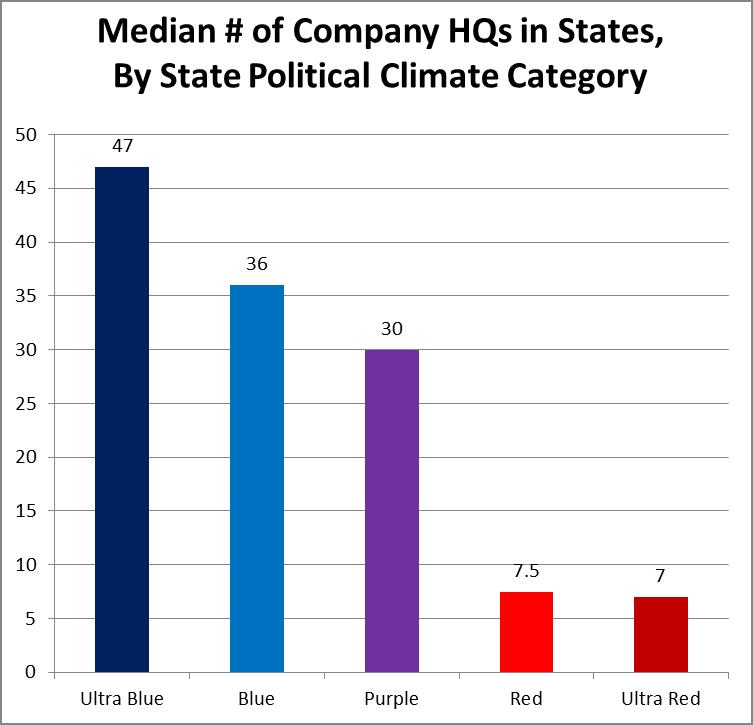
(1) By a margin of about 7:1, companies favor having their HQ in Ultra-blue v. Ultra-red states. Median # of company HQs per state variety (states by category are listed at the bottom of this post): Ultra-blue 47, Blue 36, Purple 30, Red 7.5, Ultra-red 7.
 

(2) The pattern persists when we compare lists of most popular business HQ locations: 


Top 5 Blue State HQ Locations: CA (252 company HQs), NY (159), IL (101), PA (84), MA (73).

Top 5 Red State HQ Locations: TX (176 company HQs), GA (49), VA (45), NC (37), TN (27).

Next 5 Top Blue State HQ Locations: MN (50), CT (47), MI (41), WA (31), MD (28).

Next 5 Top Red State HQ Locations: OK (17), AR (15), LA (14), KY (12), AZ (10).

So what?  There are four possible interpretations:

(1) Since the sample includes 93% of the Fortune 1000 and more than 95% of the S&P 500, one could interpret these patterns to simply mean that, by a large margin, U.S. companies perceive the best locations for running a business to be in bluer states.  As none other than Jack Welch (former GE CEO and University of Massachusetts alumnus) said during a visit to our campus in 2005, he’d favor locating a business where there’s an educated workforce and good transportation infrastructure.  Public investments in education and infrastructure tend to be favored more in blue vs. red states, so this “election result” shouldn’t surprise us.

(2) Inasmuch as the 1,686 companies in the CSRHub database tend to be publicly-traded companies about whom there is more information (either good or bad, related to environmental, societal, and economic impacts) the implication could be that companies that are comparatively more transparent tend to favor bluer states.  Depending on how follow-up regression tests turn-out, we may see a headline like this one: “Companies That Are More Transparent Tend to Locate HQs in Ultra-Blue States.”

(3) Considering that about 95% of the Global Fortune 250 now actively report on environmental, societal, and economic impacts, we ought to also test the following interpretation: “Do Companies That Engage in Sustainability Reporting Tend to Locate in Ultra-Blue States?”

(4) Presuming further that we can also test and discover that there is a connection between being transparent and/or reporting and actually being more responsible, we may see a headline that “Companies That Are More Responsible Tend to Locate HQs in Blue States.”  On a somewhat related note, Co-Founder and CEO of CSRHub Bahar Gidwani recently published an analysis of whether better performing companies tend to be located in more sustainable cities.

Regardless of which interpretation(s) one favors, the raw numbers above should provoke some substantive debate about which political, cultural, regulatory, and tax climates really are “pro-business” – it would seem that the answer is contrary to a lot of unquestioned assumptions.

We welcome comments and critiques and hope to test (soon) for causality between variables.  In case you are wondering, below is the sorting of the states based on outcomes of the most recent four presidential elections (blue states being those that tend to favor Democrats and red states being those that lean Republican, and “ultra-blue” and “ultra-red” being states with consistently greater margins of victory for the dominant party, and purple designating swing states):

Image

Posted in Uncategorized | Leave a comment

Trafigura: let’s see where we go from here?

Trafigura, the $122 billion commodities trading company, is growing fast.

With that growth has come tough choices – often under immense pressure, but where is the company going in the future?

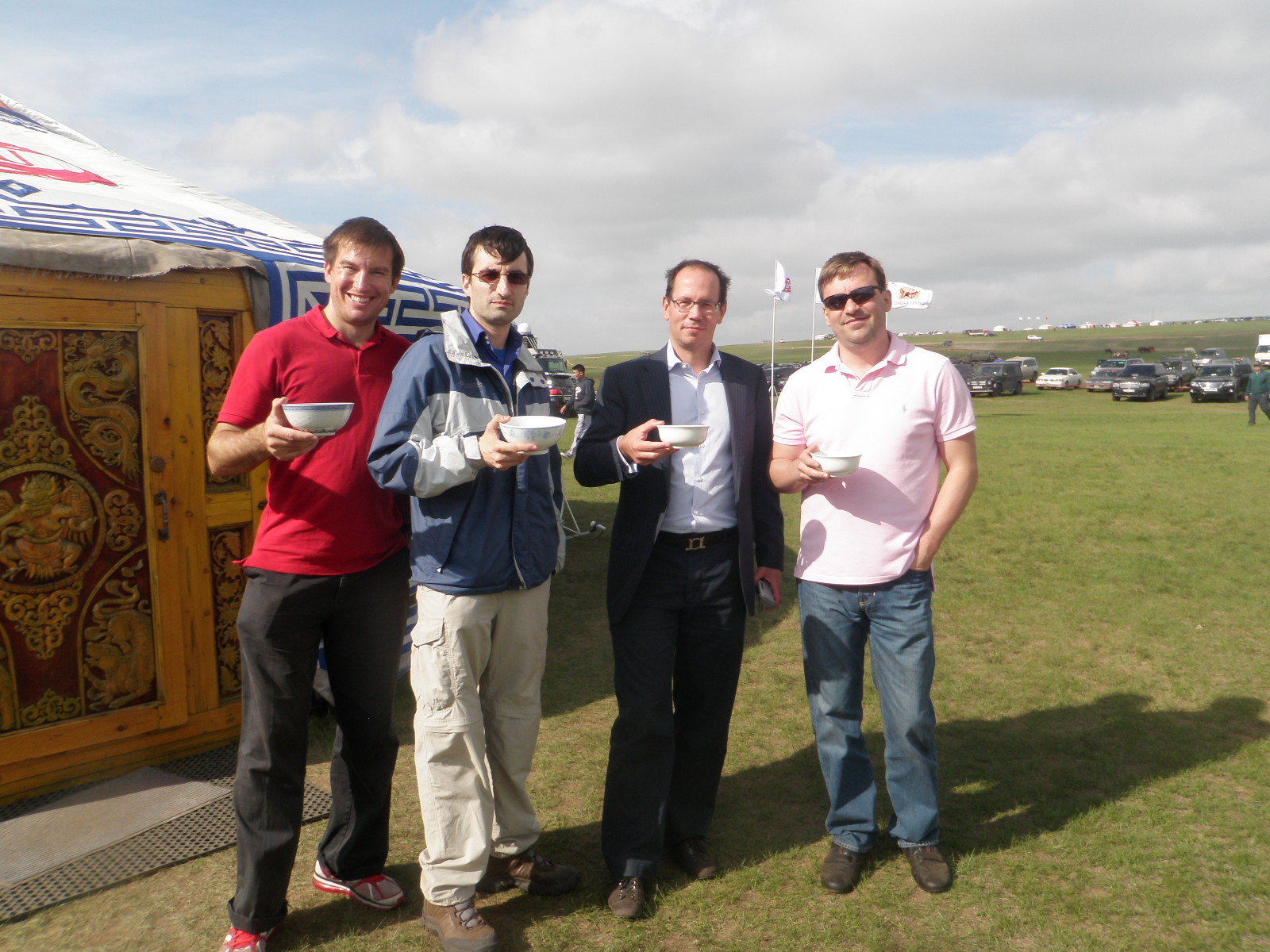
This July in Mongolia, Pierre Lorinet, Trafigura’s CFO, commented on what would make for the most intriguing educational case studies related to the company’s recent history and future plans. Here is a sampling of ideas:

(1) “how we responded” – the company has taken a beating for not only (alleged and/or real) wrongdoing, but its reaction to negative press and protests. In MBA curricula we still sometimes refer to “Shell and Ken Saro-Wiwa’s court-sanctioned murder in Nigeria” or use as shorthand “Shell in Nigeria” and “Shell and the Brent Spar incident” to allude to the nasty issue of (real or perceived or ambiguous) corporate culpability in ecological and/or human tragedies. Trafigura’s experience (before, during, and after the crisis in Côte d’Ivoire) could be even more interesting to study from the point-of-view of senior management, in that they had less time and power to identify and prevent problems before they escalated. Wouldn’t it be interesting to role play what we would do in a similar situation, and read the accounts of how people “in real life” reasoned-through their options in Trafigura’s case?

(2) “trade financing” – this is not at the tip of everyone’s tongue when we talk about critical issues to the world’s economy or well-being of our planet’s +7 billion people. What is the future of trade finance and the role of commodity-trading companies in our lives?

(3) “how we learned about sustainability in commodities trading” – in this context, I think it will be most interesting to see how Trafigura implements sustainability reporting in the coming years. Apparently this is in the works. To their credit, they don’t (according to Mr. Lorinet) want to come forward with a report that is not verifiable or is perceived in any way to be lacking. “The report needs to demonstrate the strength of our systems and processes – we will not report for the sake of it,” Lorinet said. We discussed this, and the merits of the argument that “something is better than nothing-at-all.” Mr. Lorinet said that Trafigura has already adopted better procedures and approaches to stakeholder engagement but he was also clear that there is more to be done. 

On a final note: Pierre Lorinet established his credibility with me long before we got to discussing any of these topics – early in our interactions, he described how and why he urged his sister-in-law (a quarto-lingual Mongolian) to pursue sustainability studies at an Ivy League university that she will be attending this fall. I can’t speak to the veracity of any of the accounts (positive or negative) concerning any of the news stories related to Trafigura in recent years, but, based on our interactions, my impression is that at least some of the senior management of the company have sustainability issues on their mind. As with any story, the past is prelude and the most fascinating pages are the ones yet to be written.

Image

Posted in Uncategorized | Leave a comment

Russian Green Building: Potemkin village or nascent phase?

July 3, 2012, early pm, Moscow, Russia: as I write this, I am at a building supply company in the middle of a meeting of players in the green building industry including Guy Eames, CEO and Co-Founder of the Russian Green Building Council (RuGBC – http://www.rugbc.org/en ).  As of 4pm, I’m now in a conference room of about 90 attendees at business summit in a tsarist palace, and once again, the theme of ecologically-friendly building and green standards is at least getting lip service. 

How substantive and sustainable is the green building movement here?  RuGBC revenue doubled from its first to its second full year of operations (from 2010 to 2011).  While AIG originally suggested the formation of RuGBC (apparently as a way to enhance the long-term value of its real estate investments here) and the impetus for adopting green building is to some extent based on the corporate policies of foreign companies and investors, there is clearly some nascent, local demand for progress in building standards.  Notwithstanding widespread perceptions that interests in the oil and gas and mining industries will never tolerate progress in the arena of sustainability, those with whom I’ve spoken today state that there is both market demand and government support for adopting greener construction standards.  Though the terms green building and sustainability may not be used a lot (or perhaps at all, or with a smirk in some circles in which I’ve broached the topic), the term “energy efficiency technology” has currency and credibility.  If I had not reviewed and discussed the finances and annual activities report of RuGBC and seen the products of the building supply company (including solar panels, a windmill, skylights, and appliance control technologies) I might be more skeptical and cynical about the words I’m hearing.  After today, I’m looking forward to seeing how the green building movement develops here: will it amount to the modern equivalent of a Potemkin village or a substantive shift in standards?  Image

Posted in Uncategorized | Leave a comment

June 6, 2012: Sustainability Seminar at RBS Global Operations Hub in Warsaw, Poland

June 6, 2012, Warsaw, Poland: I had the pleasure of delivering a seminar on sustainable business at the Global Operations Hub of Royal Bank of Scotland (RBS).  Beyond covering major trends, key concepts and illustrative examples, we also discussed the reasons why certain banks excelled in recent “green rankings” – and what are the best practices at their competitors that are worthy of emulation.

Posted in Uncategorized | Leave a comment

August update: A Distinguished Case Study, Master Teacher Recognition and Discussion and Tour of Grand Isle, LA.

Sid Wainer & Son: a Growing Realization, a case study coauthored with recent UMass Dartmouth Honors graduate Nicholas Vardaro, has not only been accepted into the proceedings of the Academy of Legal Studies in Business (ALSB), it also won a Distinguished Proceedings Award!

Those who went to the 2011 annual conference of the ALSB had the privilege and pleasure of attending the Environmental Law & Sustainability Section (ELSS) and Ethics Section joint luncheon.  Dr. Dean Moosavi presented slides and data on not only the BP oil spill and the ensuing clean-up, but the longer-term issue of subsidence of coastal Louisiana.  Dean took a few of us on a fascinating tour of the beaches of Grand Isle, where he helped with remediation.

Finally, our first-in-the-world A-level G3 sustainability report by a university and a synopsis of some of the assignments and material in our course, MGT600: Business Law and Corporate Responsibility, was the focus of my 35-minute presentation in the Master Teacher Symposium.  Thank you, ALSB, for the red alabaster apple!

Posted in Uncategorized | 1 Comment

Net Impact UMass Dartmouth attains gold status!

Net Impact UMass Dartmouth recently attained gold status, placing us on a list of the top 25 graduate chapters in the world.  Net Impact is a global organization whose student and professional members make the world better through their careers.  Local coverage here. Congratulations to our members!

Posted in Uncategorized | Leave a comment

ALSB ELSS

ALSB ELSS.

Posted in Uncategorized | Leave a comment

May 25 Webinar registration info

This is the next online forum in which I’ll be speaking – with registration info, etc.

This is their official announcement:

LEARNING BY DOING: Measuring Campus Sustainability

Wednesday, May 25, 2011

11AM-12:15PM EDT

ISOS Group, an international sustainability consulting group and certified trainer for the Global Reporting Initiative (http://www.globalreporting.org), will be hosting a webinar focused on the potential for sustainability reporting, rating and ranking tools to empower and educate students, the next generation of sustainability leaders. While the primary purpose of these tools is for the measuring, comparing, and advancement of campus sustainability, collaboration with curriculum development and students themselves provides a powerful tool for student learning.

The webinar will include perspectives from three panelists with an extensive group question and answer session. We are hoping to highlight both specific examples and general insight on how students can become a part of the sustainability measurement process. The webinar will explore barriers to the measurement and reporting of campus sustainability, along with success stories and benefits of student involvement in the removal of such obstacles.

Our guests are:
– Sally DeLeon, Measurement Coordinator, Office of Sustainability, University of Maryland
– Adam J. Sulkowski, Assistant Professor of Business Law, University of Massachusetts | Dartmouth
– Meghan Fay Zahniser, STARS Program Manager, Association for the Advancement of Sustainability in Higher Education

Interested professionals as well as faculty, administration and students from colleges and universities nation-wide are invited to join us.

Registration is available online: https://www3.gotomeeting.com/register/293944758
———
Paul Coraggio, Operations Intern

ISOS Group, LLC | http://isosgroup.com
sustainability reporting | external assurance | GRI certified trainings
phone: 646 584 9275
email: pcoraggio@isosgroup.com

Posted in Uncategorized | 2 Comments

End-of-April update: what do The Royal Wedding, NACUBO, ISOS Group, Earth Day, and UMass Dartmouth have in common?

April 2011 – what a month!  In typing this update, I realized that there’s a connection between organizations with whom I’ve been involved and the world’s big marital news story of the week: The Royal Wedding of HRH Prince William and Kate Middleton, specifically by way of one of the parents of the groom.  Here goes:

On April 5th I spoke at the National Association of College and University Business Officers (NACUBO) Smart & Sustainable Campuses conference at the University of Maryland at the suggestion of Bob Eccles of Harvard Business School, who is co-author, with Michael Krzus, of One Report.  If you have not heard of sustainability reporting or integrated reporting, I recommend their succinct 3-minute video intro to their book and the concept of integrated reporting and checking out the website of the International Integrated Reporting Committee (the IIRC).

What’s the connection to The Royal Wedding, you are wondering?  Well, it so happens that IIRC’s website features video commentary in support of integrated reporting from none other than the father of the groom, HRH Charles, Prince of Wales, who has started his own Accounting for Sustainability Project.

Take your pick: you can watch Prince Charles speak about sustainability reporting in his address to the World Congress of Accountants 2010 at the IIRC website (also here on YouTube) or this podcast of my session at the NACUBO Smart and Sustainable Campuses conference.  Or enjoy both!

Incidentally, though the world press didn’t publicize it as much, April 20 was both our Green Campus Day at UMass Dartmouth (2 days ahead of Earth Day 2011), where I had the great honor of being keynote speaker, and it was the day I turned 37.  Note to my students: beat my time in this year’s Boston Marathon – 2:53 (816th of 26,895 official runners on April 17, 2011) and then you can call me old.  The topic of my talk at our Green Campus Day?  You guessed it: UMass Dartmouth’s Sustainability Report – the first in the world by a university to achieve an A level of compliance with the preeminent standard for such reporting: the GRI’s G3 standard  (specifically, I opened a discussion of what we hope to do with our annual sustainability report, due December 2011).

Again, what’s the connection to the big marital news event of the week?  Just like the proud father of the groom, Prince Charles, and Bob Eccles and Mike Krzus, we at UMass Dartmouth hope our reports start to clarify the connections between our environmental and societal impacts with economic consequences and our financial performance, and that our reports become more integrated with various organizational functions and that they help in making wise decisions).

Finally, looking to the near future: on May 23-25 I’ll be speaking at a conference at Università degli Studi di Messina in Sicily and May 25 I’ll be taking part in a webinar hosted by the ISOS Group.  Both conversations will relate to sustainability reporting.  This summer I’ll also be conducting a seminar on sustainable business at the Warsaw University of Life Sciences and attending the Academy of Legal Studies in Business Annual Conference in New Orleans, Louisiana.  Stay tuned and stay in touch!

Posted in Uncategorized | Leave a comment

End-of-Feb-2011 update: thank you Cal Poly San Luis Obispo, CRD Analytics, GRI Focal Point USA, and folks in the media!

THANK YOU, CAL POLY SAN LUIS OBISPO!  A big THANKS to the students, faculty, and other community members of California Polytechnic San Luis Obispo‘s Orfalea College of Business for their warm hospitality and pleasurable discussions of how sustainable business practices can make companies more competitive.

CRD ANALYTICS + OUR MBAs = ANOTHER WORLD FIRST: in recent weeks our MBA students became the first in the world to use CRD AnalyticsSmartView360 as part of an assignment integrated into our course, Business Law and Corporate Responsibility.  SmartView360 is an investment analytics tool that rates and ranks companies based on financial, environmental, societal, and governmental information.  Our students are testing hypotheses regarding the connections between CSR performance and reputation and company stock performance, as well as trying their hand at managing funds of stocks based on CSR news and data.

WEBINAR WITH GRI FOCAL POINT USA’s MIKE WALLACE: thank you Net Impact and GRI Focal Point USA‘s Mike Wallace for a great discussion of CSR reporting using the GRI‘s framework on February 11.  If you want to hear it, sign-up with Net Impact and listen to it here.

THANKS TO ALL THOSE RESPONSIBLE FOR THE FOLLOWING COVERAGE OF OUR RESEARCH on the connection between companies’ green reputations and the happiness of their employees!  Here’s a sampling of the latest:

Posted in Uncategorized | 2 Comments